On words….
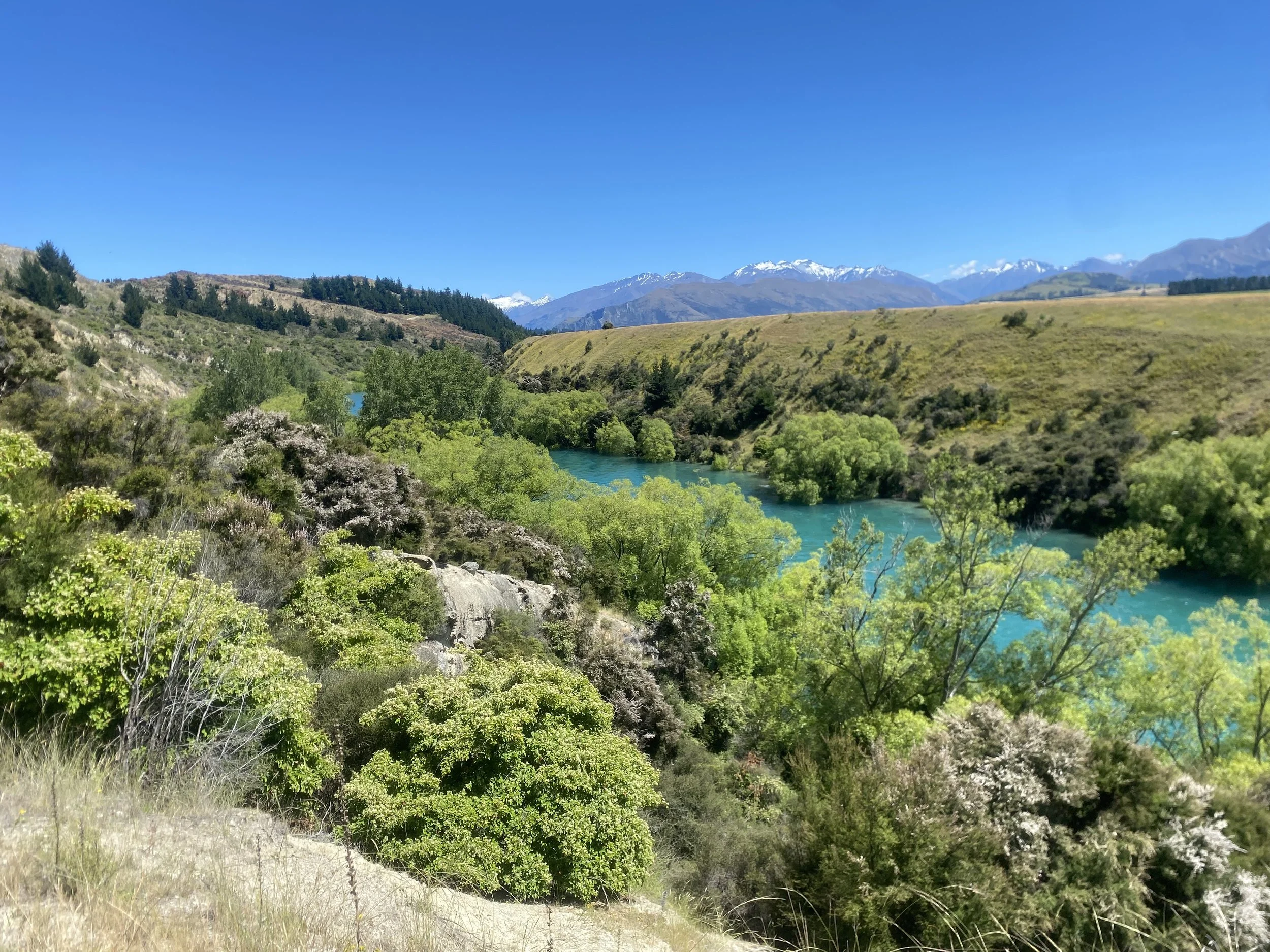
It was a glorious morning as I walked the dog today. The earth was beginning to warm up, the smell of the soil mingling with the aromatic kānuka trees. There was a shrieking from the steep side of the hill, the site of a kārearea (Aotearoa New Zealand’s native falcon) nest. A bucolic start to the day? Indeed it was.
For once, I really took in my surroundings rather than trudging with my head down, podcast playing. I set myself a task first introduced to me by my husband: trying to see how many different things I could hear, identifying the closest and furthest sounds and those in between. I really recommend trying it; it’s amazing, even on the stillest of mornings, how much you pick up when sounds become your focus.
Furthest away I could hear a helicopter hovering, presumably doing surveying or spraying; a little closer, the inevitable hum of cars during the morning commute. Closer to where I was, the rustle of rabbits in the bushes, the movement of the leaves as birds hopped from one branch to another and the snuffling of Robbie, my faithful companion, following the scents and trails that must overload him.
The hawks, the native tea trees and the simple joy of being out in nature reminded me again of Robert McFarlane’s wonderful collection of poems, The Lost Words, which seeks not only to preserve but to elevate, almost sanctify, words that were removed from the Oxford Junior Dictionary on the grounds of being irrelevant or unfamiliar to its readers. [Shameless plug: I wrote an article for The Big Idea in 2024 in which I talk more about this.]
Words have always fascinated me. The way they sound against how they look on the page; how the most mundane and everyday of words will sometimes transform before your eyes, leaving you marvelling at how strange it looks; the words you grew up with that you assumed were part of common parlance, only to discover that there are a sacred few within your family who know the word’s meaning. I love the evolution of words too and the survival of the fittest - the words that have stayed the course of time while others fall by the wayby. The words we have borrowed from other languages that we have adopted entirely into our own lexicon (I’m looking at you “avant-garde” which, in turn, was borrowed by the French from our own, more prosaic “vanguard”.)
Words change and rules change (apparently it’s OK now to split an infinitive - who would have thought it?!), t’was ever thus and it is how languages become so rich, layered and wonderfully nuanced and textured. I fear, though, for where we could be headed. If the surrounding culture and society informs our language, what does that mean in an age of AI? While I flatter myself that I can still spot a clumsy piece of AI prose, I find more and more that human-first writing sounds like AI. Is the language of AI - “seamless”, “fostering” and “robust” - now shaping how we communicate beyond the large language models? Are we heading towards a future of sterile and uniform turns of phrase and lexicons onscreen and off that feed one another, creating an infinite loop cycle? I hope not, I really hope not.
This, and for so many other reasons, is why we need to keep the unfamiliar and the irrelevant alive. There’s such a joy in hearing an expression that you’ve long forgotten, perhaps last uttered by a grandparent or read in an early 20th century book. It can be every bit as potent as the strain of that long forgotten song, the whiff of that scent last smelled as an adolescent. Words hold a meaning and a power that go well beyond their moment on screen or in print. I recently read that it’s estimated that a person is, on average, forgotten within three generations, unless you are at a Beatles, Maya Angelou, Shakespeare or Frida Kahlo level of fame. We may be referenced in family folklore or act as source of inspiration for future generations when looking back through the family tree (or will it simply be a DNA ancestry site by then?) but, other than that, we will fade away, unremembered.
Let us save our words from that same fate. Unlike the global population, there is no pressure on vocabulary - quite the opposite. Language has an infinite ability and potential for growth, it’s one of the most exciting things about it. With that growth though must come retention and a great deal of remembrance. Let the words of the past roll off your tongue and onto your page with confidence, return to the childhood joy of searching out new words (and not just the rude ones) in a dictionary and, as you write, create connections not just in the present or for the future but also with the past and the various, sometimes interwoven, sometimes parallel paths that have created our linguistic landscape in all its boundless glory.
In remembrance of things past
In remembrance of times past…
I was recently asked by the Wānaka Business Chamber to give a talk at one of their coffee mornings. A natural speaker I am not and although I agreed willingly, I was gripped by the kind of nerves that the prospect of the written word never presents to me. Apart from the obvious trepidation surrounding the very fact of standing up in front of a room full of people, there was the fact that that I would be my own subject matter, something that did not sit remotely comfortably. To frame things in a way that would be, hopefully, more interesting to the audience and easier for me, I pieced my talk, a tale of my life to date, around music; the title: Words, Wine and Whatifs: A Life in Lyrics and Lessons.
The songs weren’t necessarily my desert island discs but they were ones that, for whatever reason, were relevant to the chapter of my life in question, sometimes more for the lyrics themselves than for them having been the soundtrack to that period. And yes, my professional career, in the words of Mr Brightside, really did start off with a kiss, but that’s another story…
Regardless of musical preference, we’ve all had that time, I’m sure, when an overheard song or piece of music stops you in your tracks and immediately casts you back to another time, another place, and it can wind you, leave you breathless. You might be in the supermarket buying face wash for your teenager but you’re suddenly fourteen again, wondering which of your five plaid shirts you should wear that day as you reach for your Doc Martens. You’re driving with your window down and the strains of something coming from your neighbour’s vehicle takes you back to that day in your twenties that you’d not thought about for years, the date you’d been longing for for months that, once it finally eventuated, was nothing short of a damp squib whose only longevity was in the retelling with your friends.
As with music, so too with smells. Even now, three decades later, I can’t help myself at an airport Duty Free. If there’s a sample bottle of CK One, chances are I’ll be dousing myself in it to the same level that I did with the tester in Boots, circa 1997. As the smell hits me for the first time, I’ll be back on the high street with two best friends having just bought the single of the latest Levi’s commercial soundtrack. Every single time. Every single airport.
Then there’s chicken stock, a panacea for almost anything. Coming home from school, then later from university, there was something so incredibly comforting, so familiar about the smell of chicken stock that would hit me as I opened the front door. I’m sure my memory is convincing me that it was a far more constant smell than it actually was but when I think back to the house in which I grew up, I can smell Dad’s chicken stock just as clearly as I can hear the clunk of the front door as it yielded to the final key turn or see the scratch on my bedhead that marked where I had put a Teenage Mutant Ninja Turtles transfer, later taken off. When my children are ill, I give them chicken stock; when I am fraught, when I am in nesting mode, I make chicken stock. In action it connects me to my father and in smell, it is a thread that weaves throughout the decades, no matter where they find me.
AI may deceive us with sights and sounds on the screen and it may ultimately cost me my job. What it cannot do (yet? Who knows? I hope not!) is evoke the visceral, step-stopping, eye-closing moments that sensory memories can elicit. For that, I am truly thankful and for these moments, I remove myself from the screens of work, diversion and distraction and put on a record, step outdoors, open up my ears and breathe deep and see where it takes me…